
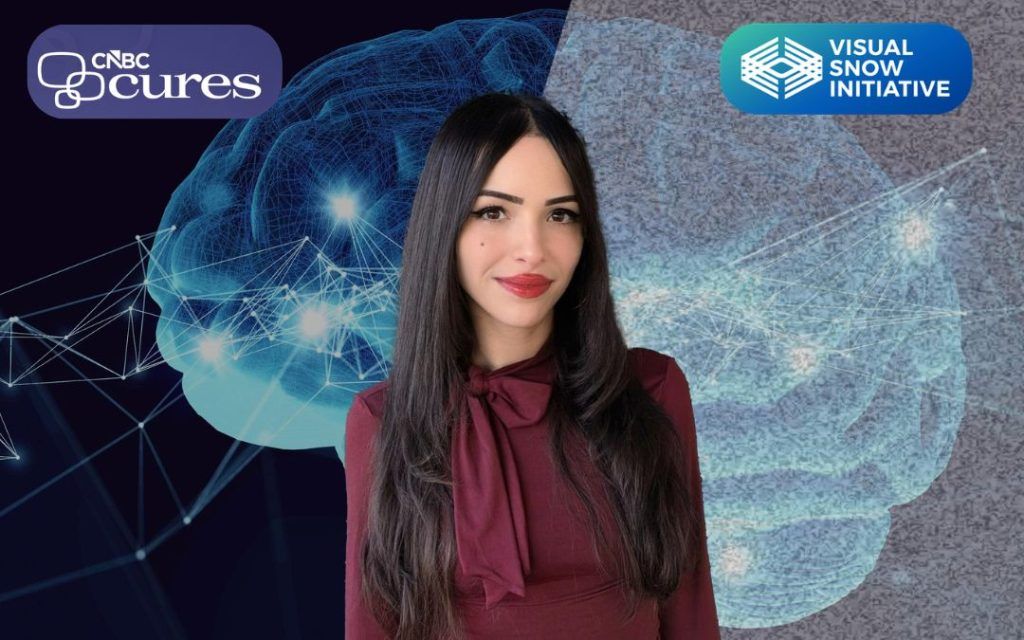
There is a path familiar to many people living with rare, misunderstood, or underrecognized medical conditions. Symptoms appear without explanation, patients spend months or years searching for answers, a diagnosis can be difficult to obtain, and that experience may ultimately lead to advocacy for better research, resources, and treatment.
In a recent CNBC Cures article featuring Sierra Domb, Founder Emeritus of the Visual Snow Initiative (VSI), Sierra shared her experience of living with Visual Snow Syndrome (VSS), searching for answers, and ultimately turning that experience into advocacy and action.
The article follows Sierra’s journey from the sudden moment her vision changed to the years of searching that followed. It also explores a larger question about healthcare.
What happens when patients experience real and life-altering symptoms, but medical understanding has not yet caught up?
When Sierra’s Vision Suddenly Changed
Sierra’s experience began in 2015. She was 21 years old and driving to university when her vision suddenly went completely black. After several minutes, her vision returned, but as Sierra explained to CNBC, it was never the same.
From that point forward, her visual world was covered by a persistent layer of moving static. She experienced thousands of flashing lights and dots throughout her vision, while images appeared to repeat or trail behind objects. These visual disturbances remained present whether her eyes were open or closed. The changes were not limited to her vision.
Sierra also developed migraines, tinnitus, electric shock-like sensations, painful sensitivity to light and sound, insomnia, and derealization. The combination of visual, neurological, and sensory symptoms became increasingly difficult to manage.
She desperately sought medical help, but testing failed to provide an explanation.
At the time, the physicians Sierra encountered were unfamiliar with a condition that could account for the full range of symptoms she was experiencing. Some questioned whether the symptoms were real. Others believed her but raised frightening possibilities, including that she might eventually lose her vision or that something potentially life-threatening was occurring.
The symptoms themselves were debilitating, but so was the uncertainty. Without an explanation, appropriate resources, or a clear path forward, Sierra eventually had to stop both school and work.
More Than a Year of Searching for an Answer
Sierra continued searching independently for information that might explain what was happening.
More than a year after the initial onset of her symptoms, she came across an article by neurologist Professor Peter Goadsby. The symptoms described in his work closely reflected what she had been experiencing. Professor Goadsby ultimately diagnosed Sierra with Visual Snow Syndrome, a neurological condition involving altered visual and sensory processing.
For people with VSS, the visual field can be affected by constant visual disturbances often compared to looking through television static or a storm of flickering dots. Additional symptoms may include afterimages, trailing images, and other visual phenomena, alongside non-visual symptoms that can also affect daily life.
For Sierra, receiving that diagnosis represented something she had been searching for since her symptoms began.
She finally had a name for what she was experiencing and, as she told CNBC, “proof that I was not alone.”
Creating the Visual Snow Initiative
At 23 years old, Sierra founded the Visual Snow Initiative. Her goal was to help advance research, resources, awareness, and medical recognition for a condition affecting people of different ages around the world, but which had historically received limited attention within the medical community.
The organization was shaped in many ways by the barriers Sierra encountered during her own diagnostic journey. She had experienced firsthand what it was like to search for information that was difficult to find, to encounter healthcare professionals who were unfamiliar with VSS, and to live with symptoms that were deeply disruptive without having a clear explanation for them.
Since its founding, the Visual Snow Initiative has worked with researchers, physicians, scientists, patients, and institutions internationally to support VSS research, increase education and awareness, develop patient and professional resources, and advance recognition of the condition.
What Happens When Medicine Has Not Yet Caught Up?
Sierra explained that Visual Snow Syndrome changed the direction of her life, but it also showed her something larger. When people are not believed, when appropriate resources do not exist, or when clinicians do not yet have sufficient information about a condition, the effects can reach into physical health, mental health, quality of life, and a person’s trust in healthcare.
As Sierra told CNBC, “Recognition is more than naming a condition.”
Recognition can validate what patients are experiencing. It can also create a stronger foundation for scientific research, clinical education, potential treatments, resources, and improved care.
This distinction is particularly important for conditions such as Visual Snow Syndrome. A patient may have symptoms that are persistent and disruptive even when routine ophthalmological or neurological testing does not reveal a conventional structural explanation. The absence of an immediate explanation does not eliminate the need to investigate what that patient is experiencing.
Why Patient Experiences Matter to Research
Science is essential for determining the mechanisms behind a condition, establishing diagnostic criteria, evaluating interventions, and developing evidence-based treatments. At the same time, patients can help reveal where scientific understanding remains incomplete. Their experiences may identify recurring symptoms that need to be studied, gaps in healthcare that need to be addressed, or questions researchers have not yet had the opportunity to investigate.
Sierra emphasized that the future of medicine depends not only on discovering new treatments, but also on listening carefully to patients whose experiences may reveal aspects of human health that science does not yet fully understand.
In her words, “Medical progress requires both scientific rigor and humanity.”
Patient experiences can identify the questions. Researchers and clinicians can then investigate those questions using scientific methods, clinical research, neuroimaging, epidemiology, treatment studies, and other forms of evidence.
Progress happens when these areas are able to inform one another.
From a Search for Answers to Greater Recognition of VSS
Sierra’s individual search for an explanation ultimately became connected to a much larger international effort surrounding Visual Snow Syndrome.
Research collaborations expanded. Scientific publications increased. Greater numbers of clinicians and researchers became familiar with the condition. Educational resources were created for both patients and healthcare professionals.
The medical framework surrounding VSS also continued to develop.
CNBC highlighted the Visual Snow Initiative’s work toward formal recognition of Visual Snow Syndrome within international medical classification, connecting Sierra’s advocacy to the broader progress that has occurred since her own search for a diagnosis began. For a condition that many patients once struggled even to name, these developments represent an important transformation.
However, recognition is not the end of the work.
There are still major scientific questions surrounding Visual Snow Syndrome, including its underlying neurological mechanisms, why symptom profiles and severity differ between individuals, the relationship between visual and non-visual symptoms, and how effective treatment strategies can continue to be developed.
These unanswered questions are precisely why continued research remains essential.
The Power of Patients to Help Drive Progress
At the conclusion of the article, CNBC highlighted what Sierra’s journey represents for the broader rare disease community, particularly the ability of patients to help drive progress.
Today, Sierra serves as Founder Emeritus of the Visual Snow Initiative, and VSI continues the mission that grew from that original search by advancing awareness, education, research, resources, recognition, and hope for people affected by Visual Snow Syndrome worldwide.
We are grateful to CNBC Cures for featuring Sierra’s story and for highlighting a message that extends far beyond VSS